Options Greeks Calculation Methodology
Last updated: July 14, 2026
Overview
This document describes the quantitative methodology used to calculate option greeks and implied volatility. Our calculations are grounded in the widely accepted Black-Scholes framework, supplemented by robust data-quality rules to ensure that only reliable market prices feed into the computation.
1. The Black-Scholes Pricing Model
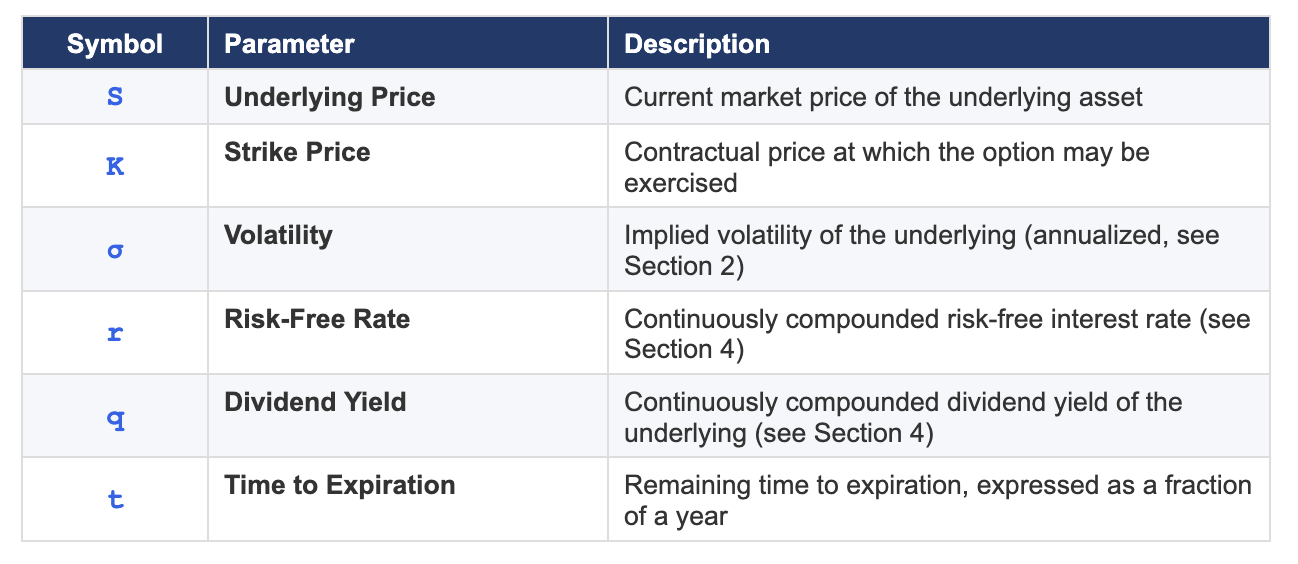
We calculate option greeks using the Black-Scholes model, the industry-standard framework for pricing European-style options. The model expresses option value as a function of six inputs:
1.1 Intermediate Variables
Before computing prices and greeks, two intermediate values are derived:

N(·) denotes the cumulative standard normal distribution function and N'(·) its probability density function.
1.2 Option Prices

1.3 The Five Greeks
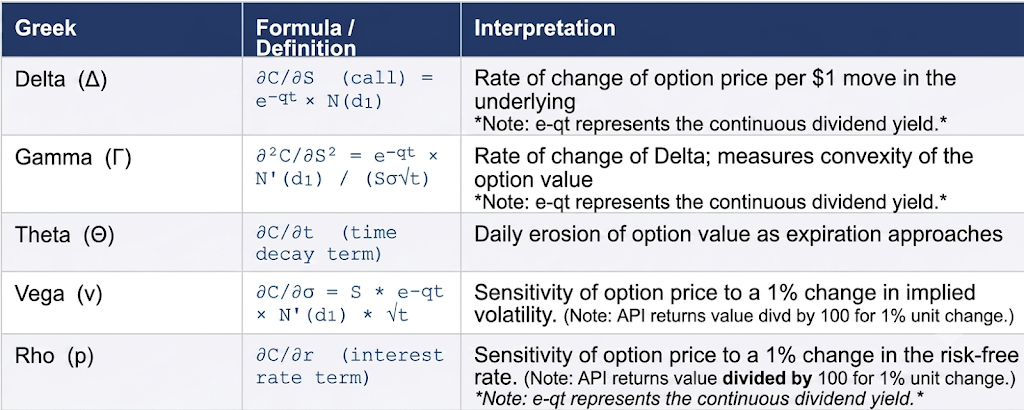
The partial derivatives of the option price with respect to each input parameter give the greeks. The table below shows the closed-form expressions and their practical meaning:


2. Implied Volatility
The Black-Scholes model requires volatility (σ) as an input, but volatility is not directly observable in the market. Instead, we derive it from current option prices — this derived value is called implied volatility (IV).
2.1 The Root-Finding Problem
Given the five observable inputs (S, K, r, q, t) and the market price of an option C₀, implied volatility is the value of σ that satisfies:

2.2 Newton-Raphson Iteration
We solve this equation numerically using the Newton-Raphson method, which starts from an initial guess and iteratively refines the estimate by following the slope of the pricing function toward zero.

2.3 Convergence Strategy
The algorithm proceeds through the following steps:
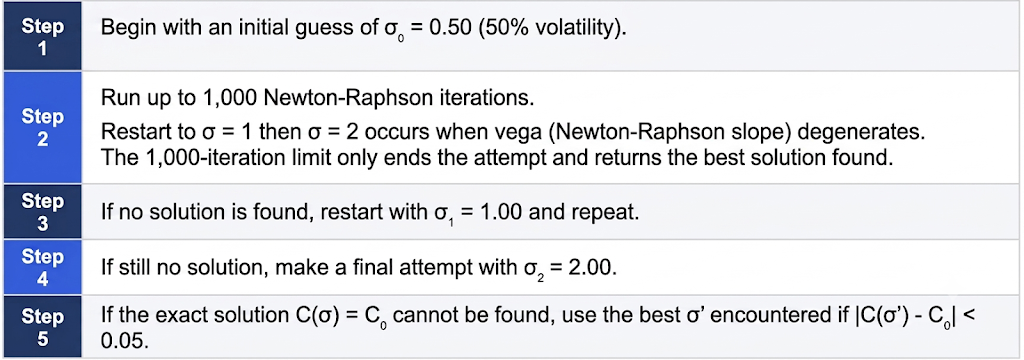
Performance note: In the vast majority of cases, convergence is achieved within 5 iterations.
3. Option Price Selection
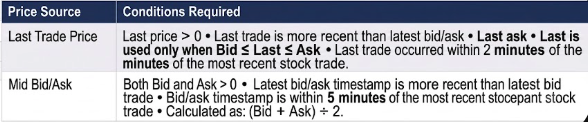
Because implied volatility is derived from observed market prices, the quality of the input price is critical. Options are often thinly traded, and stale prices can materially distort greek calculations.
For each option contract, we select between the last trade price and the mid bid/ask price according to the following rules:

4. Market Data Inputs
4.1 Dividend Yield
We use the trailing twelve-month dividend yield for each underlying security sourced from FactSet Fundamentals. This continuously compounded yield is used directly as the q input in the Black-Scholes formula.
4.2 Risk-Free Interest Rate
The risk-free interest rate (r) is obtained from market data providers and varies by options market:
OPRA (U.S.) options: 3-Month U.S. Treasury Constant Maturity rate.
XMOD (Canadian) options: Canadian 3-Month Treasury Bill rate.
The applicable rate is used consistently across all option calculations for the corresponding market, regardless of expiration tenor.
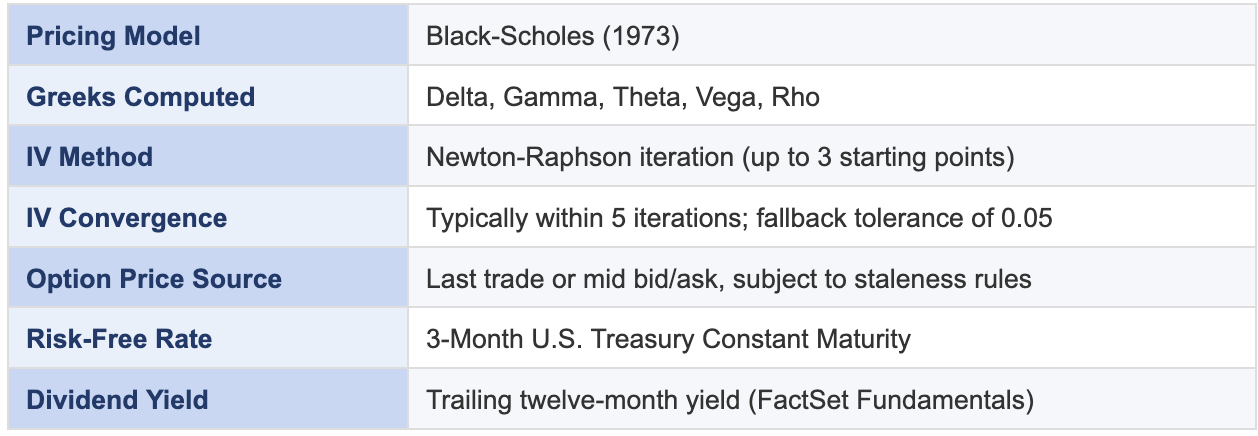
5. Summary